
Solar & Energy Storage with Real Time Energy Pricing
Introduction
A lot of people become interested in solar as a way to make it through grid-down situations. Let’s follow-up on our real time pricing scenario and see how solar coupled to an energy storage system (ESS) compares to a backup generator.
Solar + Energy Storage Overview
As with the real time energy pricing case study, surplus energy is still sold to the grid. However, with energy storage included, priority is given to charging the batteries whenever their charge status is lower than 100%. At other times, the batteries power the home, so long as sufficient charge is available:
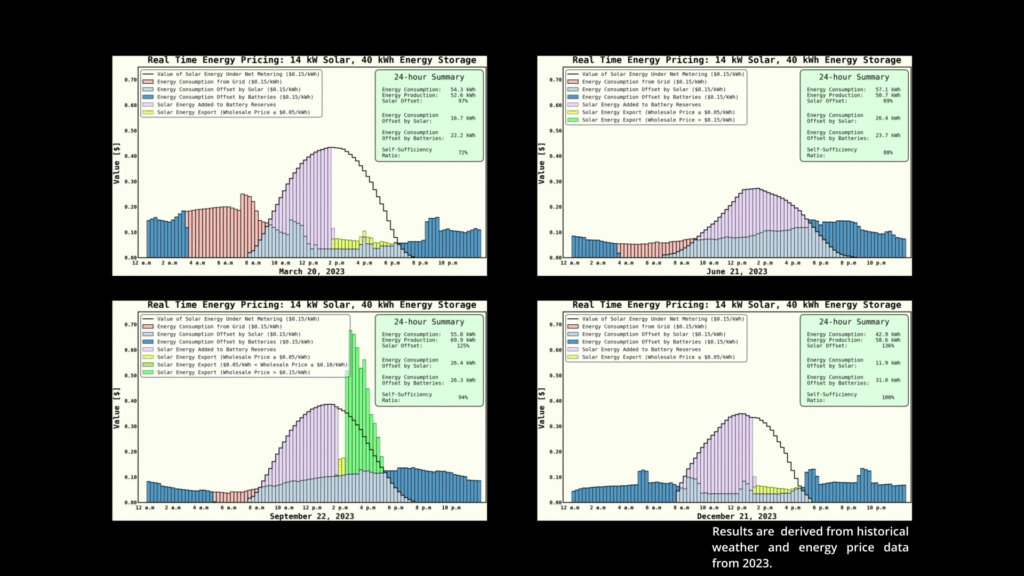
This definitely reduces the power bill. However, batteries are not free. If one is comparing this to a traditional natural gas generator, it has to be cost-competitive. Traditional natural gas backup generators are usually installed to power an entire home.
When designed for total-home backup, energy storage systems can get expensive very quickly. This is because the storage capacity required for complete backup starts around 40 kWh to 50 kWh. At close to $1000/kWh, going this route is far more expensive than a comparable generator.
Effect of Solar + Energy Storage on an Electricity Bill with Real Time Energy Pricing
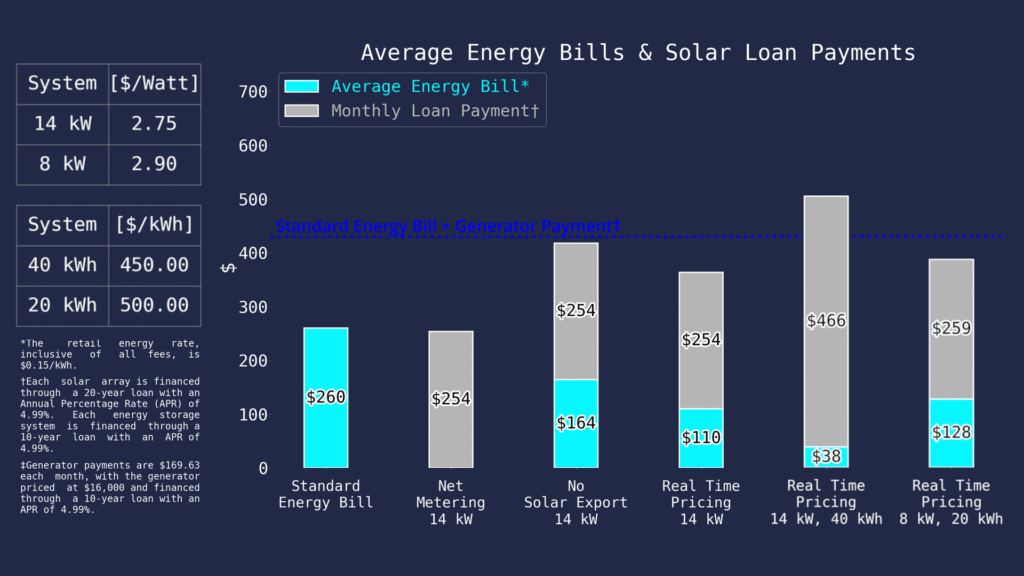
Picking up where we left off with a 14-kW solar array and real-time energy pricing, we add a 40-kWh ESS:
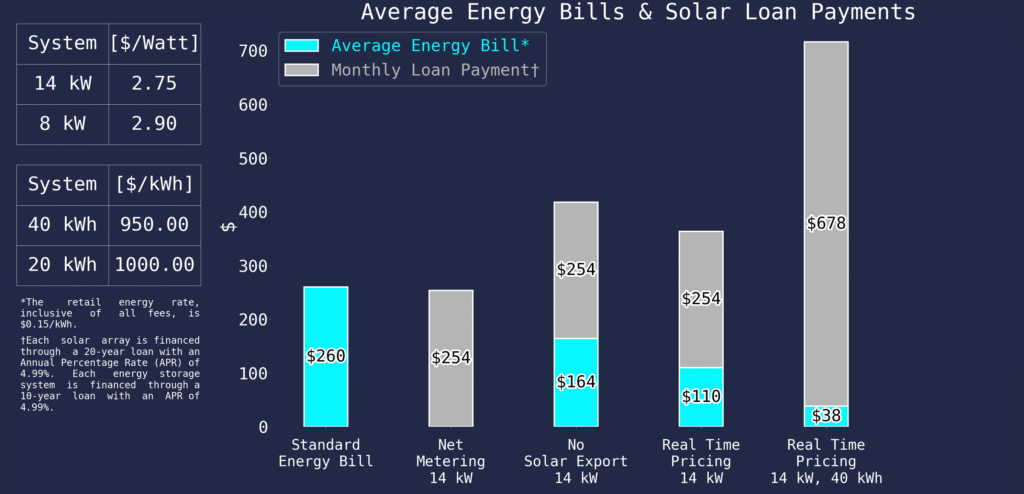
As expected, the energy bill is substantially reduced, yet the energy storage system also entails substantially higher loan payments.
Since batteries experience efficiency losses more rapidly than solar panels, we assume a 10-year loan for the energy storage system rather than a 20-year loan as with the solar array. For the sake of comparison with the energy storage system, we assume that the hypothetical 20-kW generator will be financed with a 10-year loan as well:
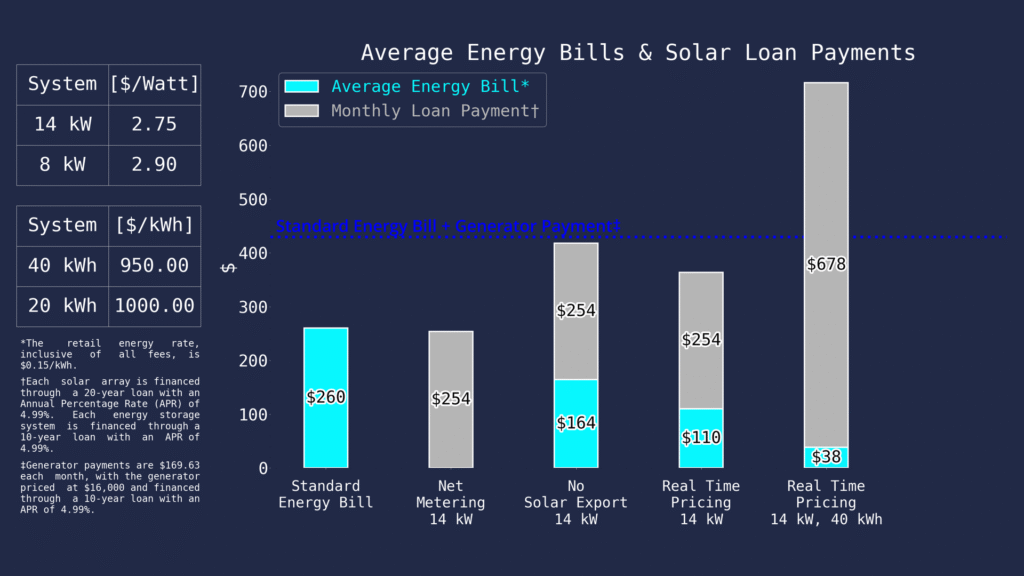
What if we take the middle-of-the-road approach as we did in our previous scenario, by downsizing the system? An 8-kW solar array with a 20-kWh ESS will provide a partial backup during a power outage, and also reduce the energy bill, which helps justify its cost:
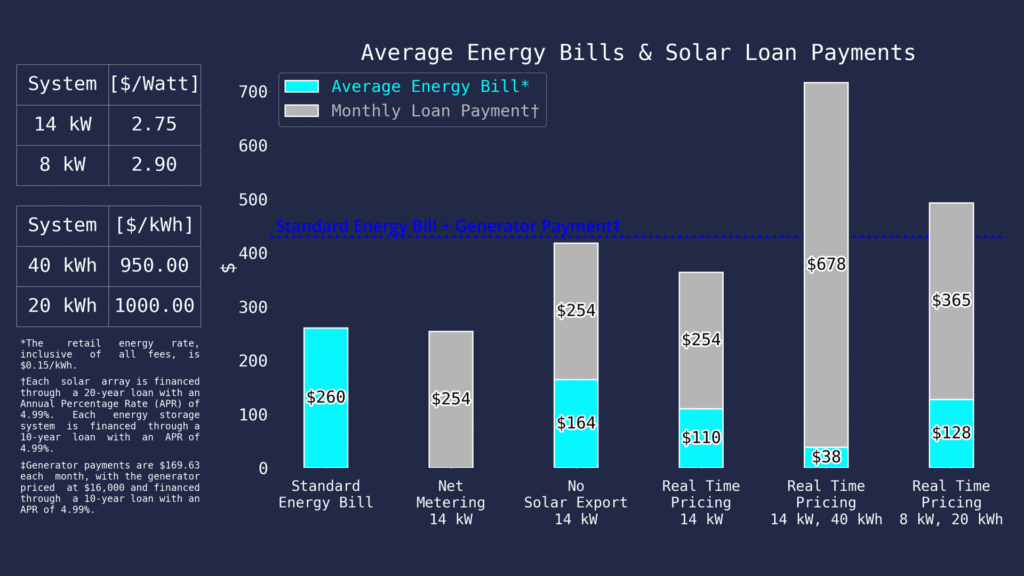
While it may be possible to run the primary HVAC unit with a 20-kWh ESS during a power outage, it is generally not advised. However, a strategically placed portable A/C unit can make a power outage quite tolerable and still leave a reasonable amount of energy in reserve for other priorities.
Portable Power Stations — A New Alternative
Up until now, we’ve discussed grid-tied energy storage systems. Setting-aside grid-tied systems for a moment, portable power stations which are commonly used for camping trips and recreational activities can also be used to power the essentials at home during a power outage. Although they lack the automation offered by grid-tied energy storage systems coupled with a smart transfer switch, they allow one to forego the installation costs and power a select few devices without necessarily relying on a gas-powered generator. That said, a gas-powered generator can help recharge batteries even in adverse weather conditions (as long as the battery’s charge controller is designed with this function).
A pair of 10-kWh batteries coupled with solar panels should be more than adequate to keep a refrigerator, a (reasonably operated) portable A/C unit, and a few other essential devices in operation during a power outage.
Summary
In summary, some prefer the aesthetics of modern batteries over natural gas generators and pay a premium for this preference. However, for many, the responsible financial decision is to get a generator, or to go the solar route, and simply limit the size of the energy storage system until a later date. Portable power stations offer yet another a middle-of-the-road solution that many people find perfectly adequate. As the costs of energy storage decrease, the all-in cost of solar coupled with energy storage is likely to approach that of a typical energy bill plus the cost of a generator.
In the next article in this series, we discuss time of use (TOU) energy policies with solar+ ESS.