
Solar & Energy Storage with Time of Use Energy Plans
What are Time of Use Energy Plans?
Time of use (TOU) plans charge customers for their energy usage according to a price that varies throughout the day. On-peak rates usually occur in the late afternoon and early evening when people tend to consume high amounts of energy, and off-peak rates occur during the other times. Some plans have three pricing tiers rather than two; they consist of an on-peak rate, an off-peak rate, and a super-off-peak rate (which usually occurs late at night and early in the morning when energy consumption is low). These plans in particular are well-suited for people that own electric vehicles and charge them overnight. Looking back at the energy market wholesale prices from the real time pricing article, one can see why some energy companies are interested in raising energy prices during on-peak hours, especially during the summer months.
The effects of TOU pricing are numerous.
Of course, the higher prices during peak hours allow energy companies to remain profitable. Additionally, there are secondary effects of this pricing mechanism: the downward pressure on energy demand during peak hours reduces consumption at those times, thereby stabilizing the grid. Furthermore, it incentivizes the installation of residential energy storage systems (ESSs). Because on‑peak rates occur when batteries are typically fully charged by rooftop solar, the batteries can naturally offset the most expensive usage, shielding owners from exorbitant rates in the late afternoon and early evening.
However, even if someone gets a great deal on a solar array and an accompanying energy storage system, they are still paying tens of thousands of dollars for equipment and installation costs, which may or may not be justified by the energy bill offset that the system provides. The degree to which the system “pays for itself” depends on the particular TOU energy plan, and an assortment of other factors.
We will look at three different TOU plans paired with the same energy consumption and production profiles, from the first few case studies in order to explore various possible outcomes with this type of energy policy.
Three TOU Policy Examples:
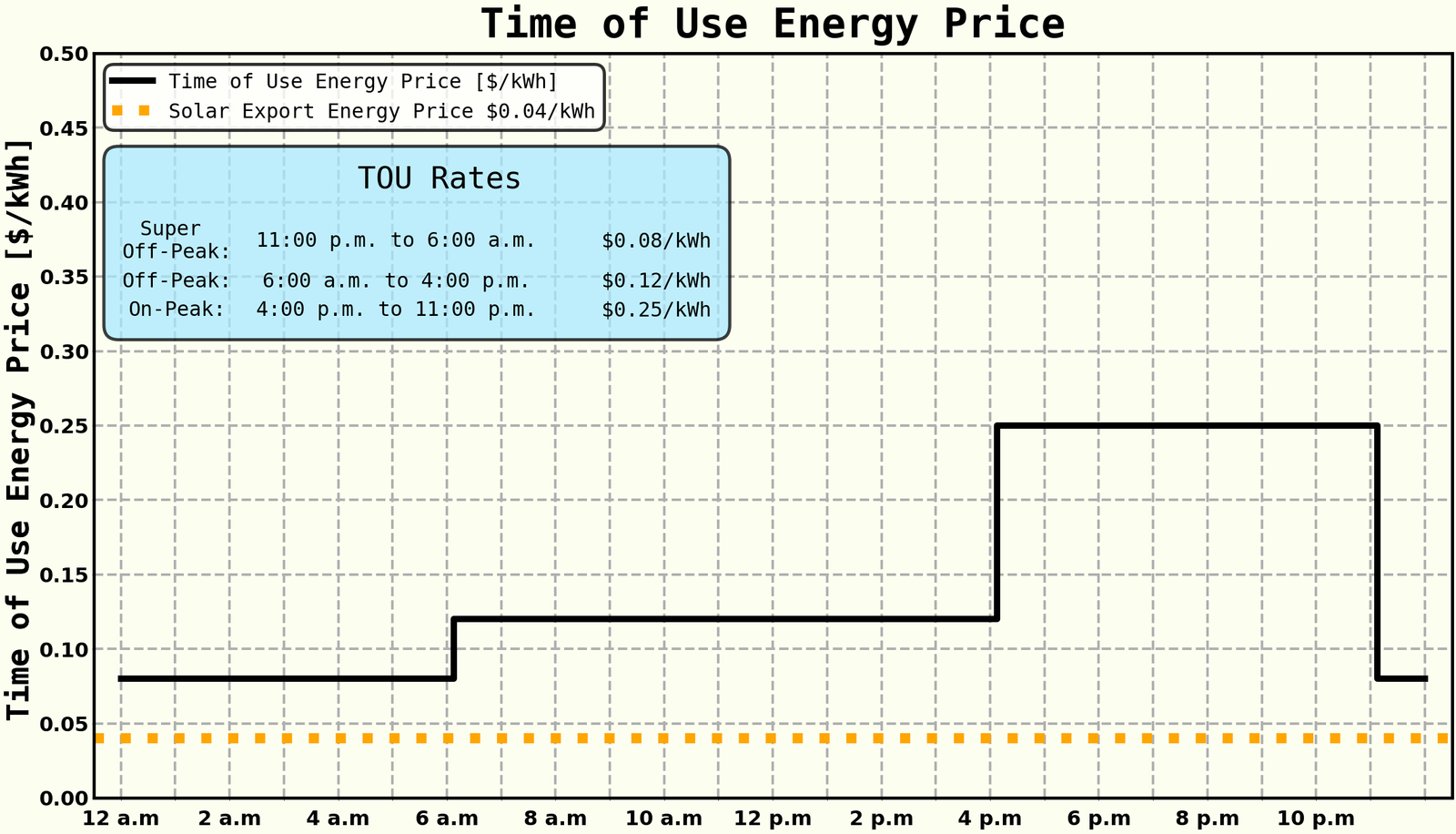
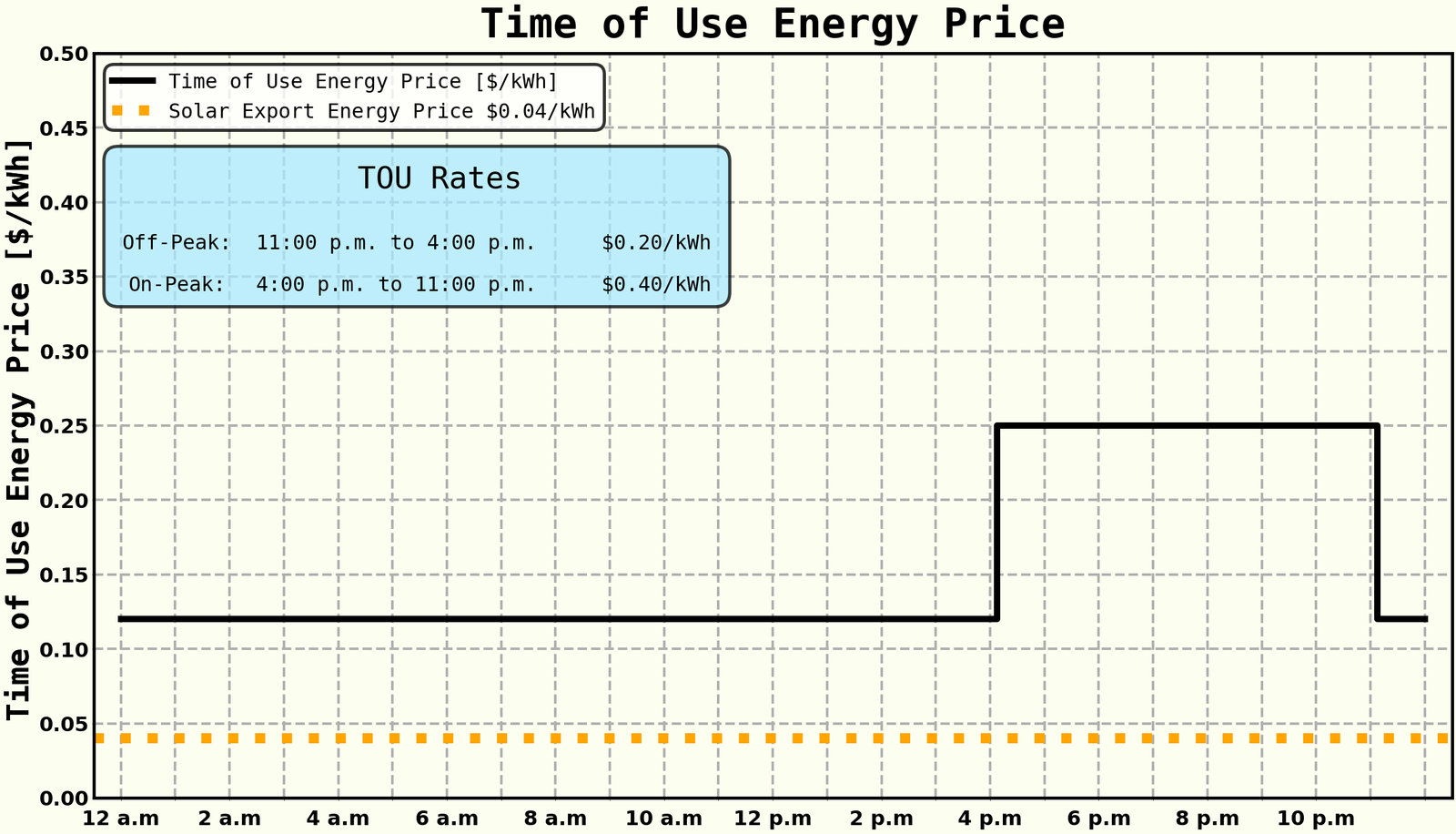
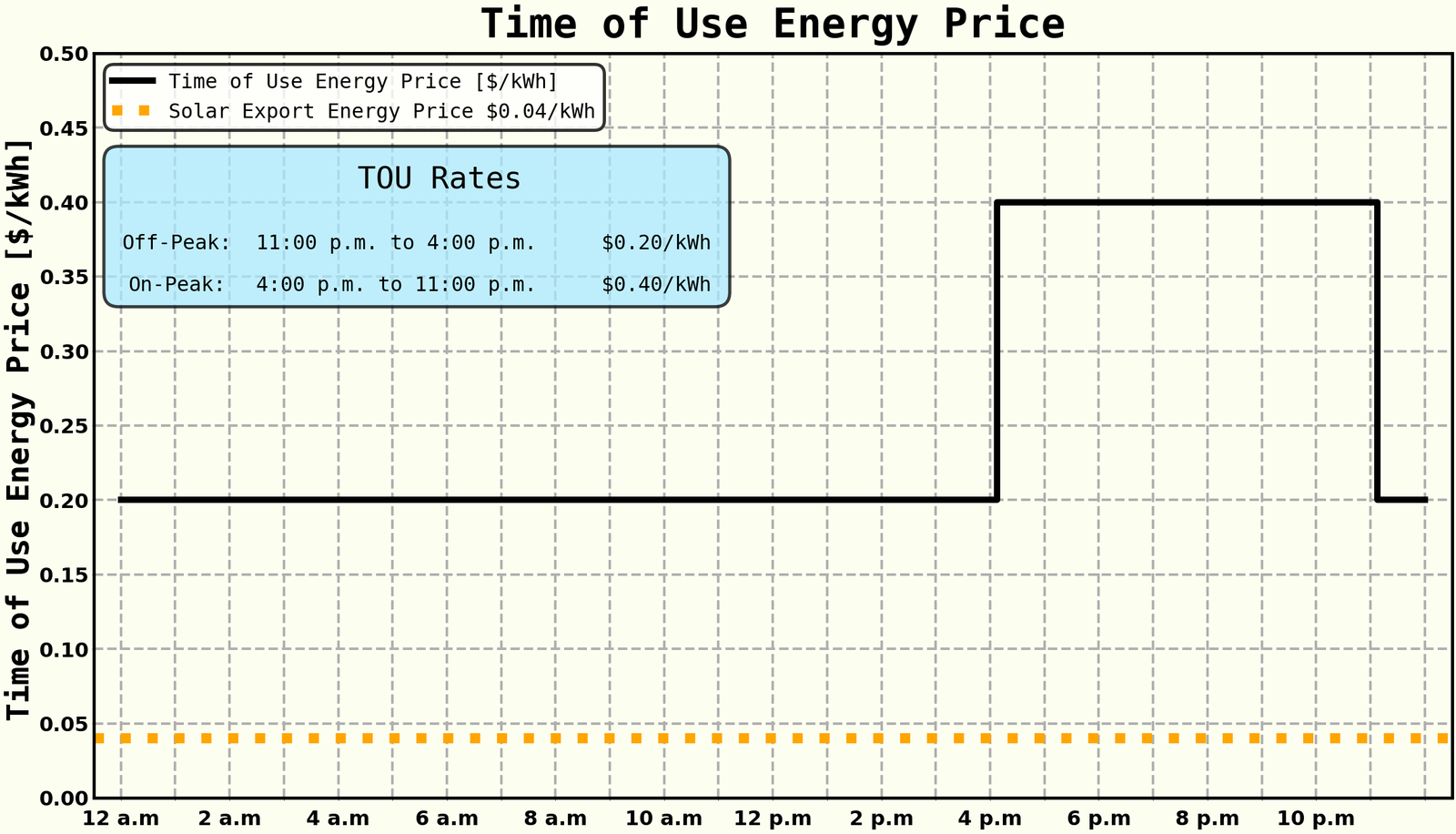
The three TOU policies we will consider are visible in the charts below. Each of these policies values solar energy exports at $0.04/kWh. There is one three-tier TOU policy, and a couple of two-tier TOU policies, with one two-tier plan considerably more expensive than the other.
Results
In the figure below, we focus on an 8-kW solar array coupled with a 20-kWh ESS. For reference, the “Standard Energy Bill” at $0.15/kWh (without solar + ESS) and the “Real Time Pricing” plan (with solar + ESS) are included in the comparison. The two lower-cost TOU plans are also considered in this initial comparison (both with and without solar + ESS). Although it’s not a remarkable difference, we notice that without solar + ESS, the two TOU energy bills are higher than the standard energy bill. Yet, with solar + ESS, the TOU plans appear to be the preferred option over real time energy pricing (if only slightly). For each plan, the monthly premium that is paid to acquire an 8kW solar array coupled with a 20-kWh ESS is shown in gold, while the blue dashed line represents the cost of a generator added to the standard electricity bill.
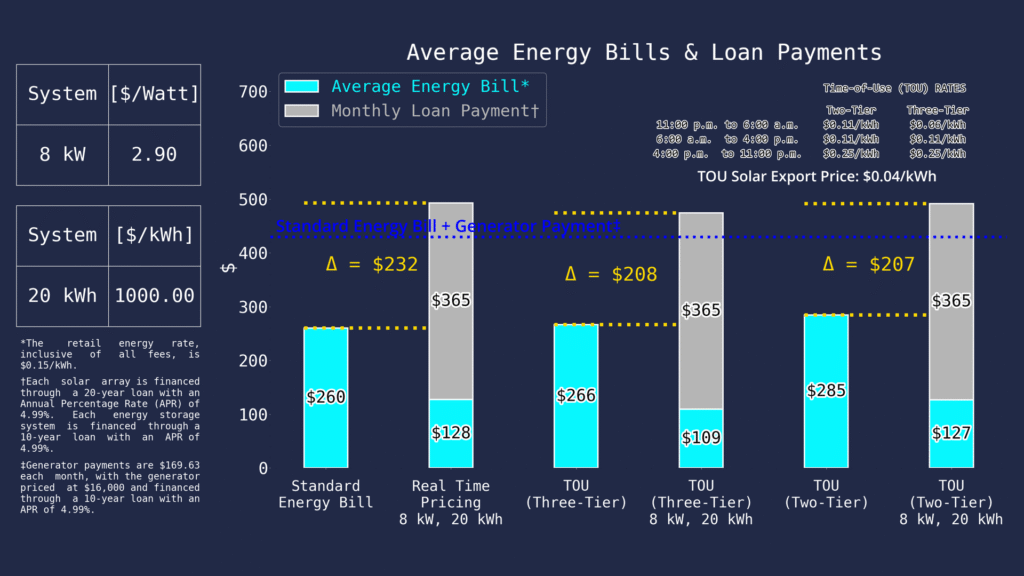
Focusing on the TOU plans, and including the last TOU scenario (higher-cost) from above, we see that higher on-peak energy prices increase the apparent economic utility of energy storage systems to pay for themselves while simultaneously serving as a rechargeable backup energy supply during potential power outages.
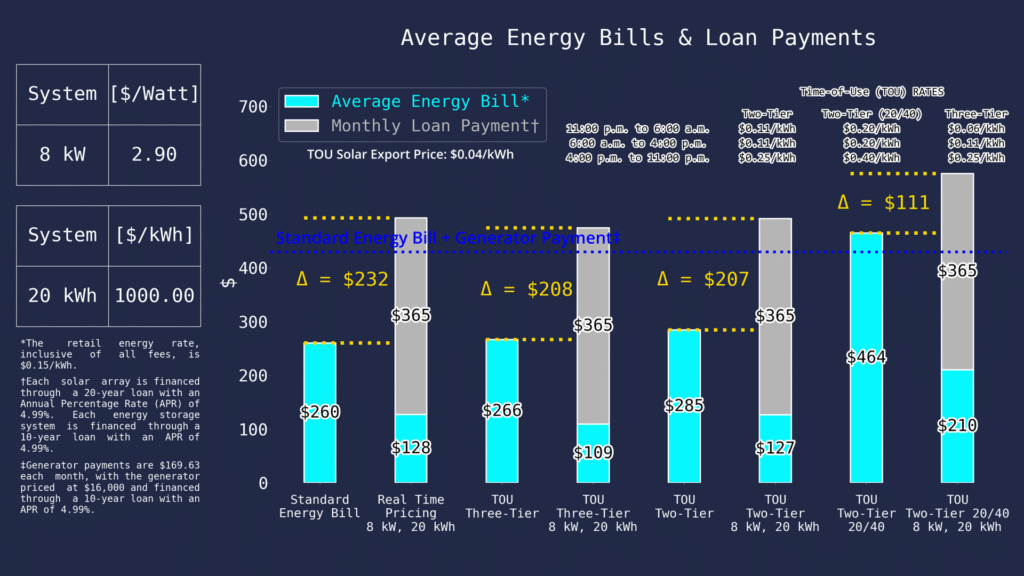
With the first two TOU plans, the 8 kW + 20 kWh system performs even better than it does with real time energy pricing, lowering the apparent cost of solar + battery home backup. However, it is only with the third TOU plan shown, the “Two-Tier (20/40)” policy, that the 8 kW + 20 kWh system appears truly cost-competitive with an installed natural gas backup generator. The energy prices for the third TOU plan (on-peak at $0.40/kWh, and off-peak at $0.20/kWh) would be considered outrageous in most regions of the United States, except perhaps in California1 and other states known for high energy prices.
That said, if your area faces high energy prices across the board, and your only option is such a TOU plan, the opportunity cost of acquiring solar + ESS is relatively low.
Conclusion
With TOU energy plans, batteries can help offset the most expensive energy usage during on-peak hours, thus lowering the energy bill substantially. In some cases, a considerable fraction of the remaining energy consumption might even take place during super-off-peak hours. Some TOU plans, especially plans with large price differences, are occasionally stated to even make batteries a profitable move. This is not the case with the scenarios described in this article. However, in some cases, it is possible that solar coupled with energy storage can prove less costly than installing a natural gas generator and continuing with a business-as-usual TOU energy plan.
Energy providers will always have economies of scale on their side in regard to clean energy technologies, and this will likely prevent residential energy projects from completely “paying for themselves” entirely without subsidies. However, energy companies cannot necessarily guarantee delivery of power at all times, mostly due to inclement weather. Therefore, one might still benefit from an in-home system that is at least cost-competitive with alternatives such as natural gas generators. In certain areas, with a reasonable reduction in equipment costs, this is a realistic goal.
- Keep in mind that this case study is based upon the same energy consumption and production profiles as our previous examples. Click here to read the details. A TOU plan which is similar to those above may or may not exist in your own region, and it is important to remember that your own energy consumption/production profile will have a substantial impact on your results. Future articles will discuss this topic in further detail. ↩︎